
Buying an older Waterloo home can come with a few mysteries. You may know the house gets warm every winter, but you may not know what produces that heat, how it reaches each room, or what the existing system means for future upgrades.
Before comparing replacement equipment, start with the house itself. Understanding the heating systems in older Waterloo homes can help you make better decisions about cooling, renovations, heat pumps and eventual replacement.
You Bought the House, But Did You Inherit a Boiler or a Furnace?
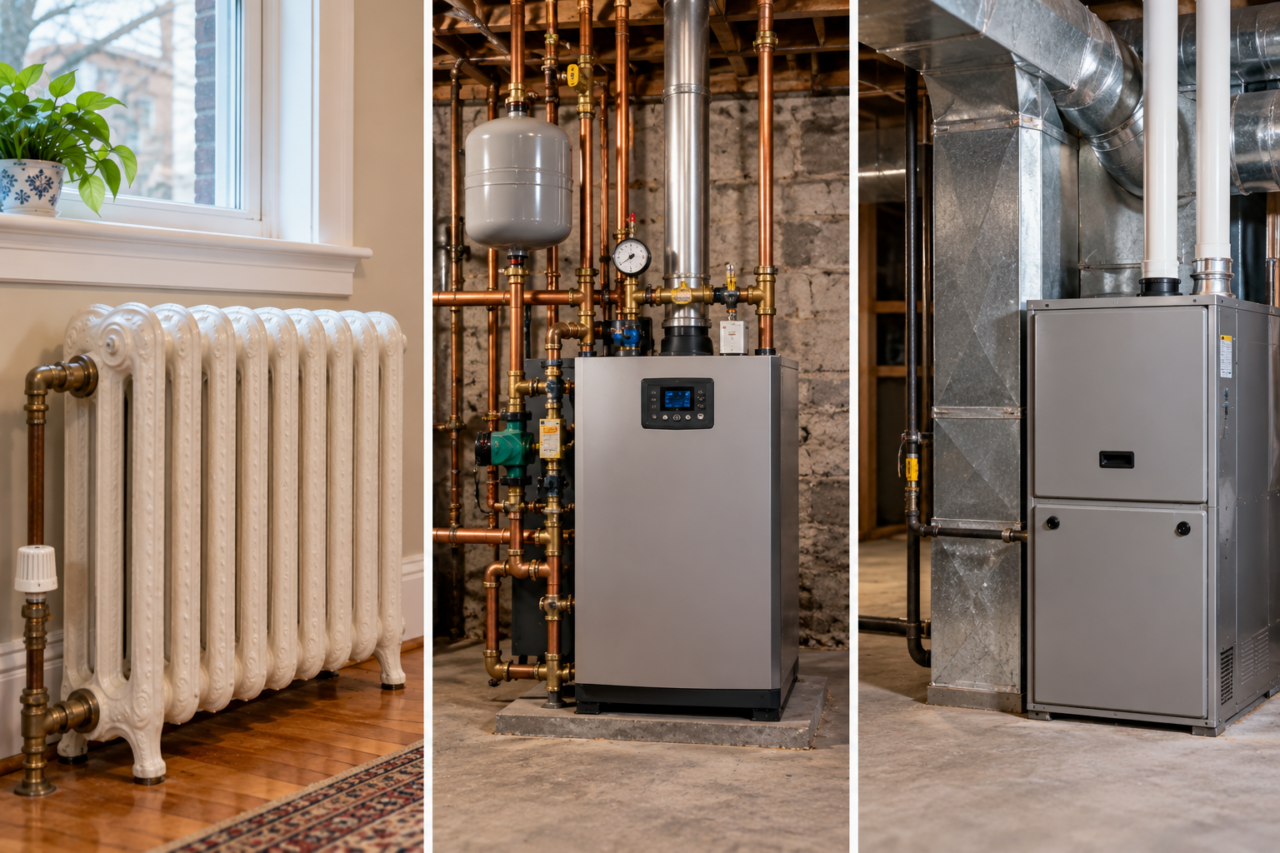
A furnace and a boiler both heat a home, but they work very differently. A furnace heats air and distributes it through ductwork, while a boiler generally heats water that circulates through a hydronic distribution system.
That difference may not matter much when you simply turn up the thermostat. It becomes much more important when you want to add air conditioning, renovate part of the house, replace aging equipment or change how the home is heated.
The first question, therefore, is not “What should I buy?” It is “What do I already have?”
Start With the Simplest Clue: Where Does the Heat Come Out?
Walk through the house and look at where the warmth enters each room. You do not need to identify every pipe or piece of mechanical equipment to begin narrowing down the possibilities.
If you see supply registers or vents connected to ductwork, the home likely has some form of forced-air heating. If you see radiators or other water-based heating emitters, you may be looking at a hydronic system.
Then look at the mechanical room or basement. The combination of what you see upstairs and downstairs can begin to tell the story.
This basic inspection will not answer every question, particularly in a house that has been modified over several decades. However, it gives you a useful starting point for understanding the home’s existing heating and cooling equipment.
Radiators Aren’t the Heating System
One of the easiest mistakes to make is referring to the radiator itself as the heating system. A radiator is better understood as part of the system that distributes heat into a room.
In a hot-water radiator heating system, heated water circulates through piping and radiators before returning through the system. The boiler is the equipment responsible for heating that water.
Even then, avoid assuming that every radiator tells you exactly what equipment is installed in the basement. Older homes can have unusual configurations, abandoned components and systems that have been modified over time.
Boilers can also serve heating systems that look nothing like traditional cast-iron radiators. For example, some homes use in-floor heating, where heat is distributed through the floor rather than through a visible radiator.
What Owning a Boiler-Heated Home Changes
If your home has hydronic heating, you are starting with different infrastructure than a house designed around forced air.
The existing pipes and radiators may continue to be useful for heating, but they do not provide a pathway for moving cooled or filtered air around the house. If there is no ductwork, adding conventional central air conditioning may require a different approach than it would in a forced-air home.
Renovations can introduce additional questions. Moving or removing radiators, changing floor plans, finishing previously unfinished areas, or building an addition can all affect how the existing heating system needs to operate.
That does not mean a boiler-heated home needs to be converted. It means the hydronic distribution system needs to be included in the planning.
What Owning a Forced-Air Furnace Home Changes
A furnace-based house generally uses a network of supply and return ducts to circulate conditioned air. That creates a different starting point for both heating and cooling.
Existing ductwork may potentially be used for central cooling, filtration and certain future system upgrades. However, the fact that ducts exist does not automatically mean they are suitable for every new piece of equipment.
Their size, layout, condition and ability to serve different parts of the house still matter. Older homes may have ductwork designed for an earlier system or altered during previous renovations.
The equipment is only one part of the picture. Distribution matters too.
The Complication: Some Older Homes Have More Than One System
Older houses do not always have one neat mechanical system serving every room. Decades of renovations can leave behind a collection of solutions from different periods.
The original portion of a home might use radiators, while an addition uses forced air. A finished basement could have another heating method entirely. Equipment may have been replaced without completely changing the original distribution system.
That is why identifying one radiator or one supply register does not necessarily explain the whole house.
If you have recently purchased an older Waterloo home, it can be useful to map which equipment serves which areas. That information becomes especially valuable before a renovation or major HVAC investment.
Want Air Conditioning or a Heat Pump? Identify the Distribution System First
This is where knowing what you inherited becomes particularly important.
Suppose you want to install an air-source heat pump. Before choosing equipment, you need to understand how heating and cooling can actually be distributed throughout the house.
A home with suitable existing ductwork presents one set of possibilities. A radiator-heated house without ducts presents another. A mixed-system house may require an approach that considers different areas separately.
None of those situations automatically rules a technology in or out. They simply affect what needs to be evaluated before equipment is selected.
This is also why comparing a boiler vs furnace based only on the appliance can be misleading. The larger question is how the entire home is designed to deliver heating and cooling.
Renovating? Don’t Design Around the Old System by Accident
Major renovations are an opportunity to think beyond the equipment currently sitting in the basement.
Walls may be opened. Floors may be replaced. Rooms may change function. An addition may substantially change the amount of space that needs heating and cooling.
Those decisions can create opportunities to rethink parts of the mechanical system. In some projects, homeowners may want to investigate whether radiant floor heating is appropriate for an older home.
The important point is to make those decisions deliberately. Professional mechanical system design can consider the house, existing infrastructure and renovation plans together rather than treating heating and cooling as an afterthought.
Otherwise, new walls and finishes can unintentionally lock in assumptions about equipment that may soon need to change.
When Keeping the Existing Heating System Makes Sense
Finding an older boiler, furnace or radiator system does not automatically mean it should be removed.
An existing system may continue to fit the house and the homeowner’s plans. Its condition, maintenance history, performance and compatibility with future renovations all need to be considered.
In other cases, an upcoming renovation or aging equipment may make it sensible to investigate alternatives. The key is that modernization should not automatically be confused with replacement.
Understanding the system comes first. The decision about whether it stays, changes or becomes part of a larger retrofit comes afterward.
Before You Replace Anything, Understand the House You Have
When exploring heating options for older homes, it is tempting to begin with equipment. A homeowner might start researching a new furnace, boiler or heat pump before determining how that equipment would work with the house.
A better starting point is the complete mechanical picture. Identify the heating equipment, determine how heat reaches each part of the home, examine the existing distribution infrastructure and consider what you want to change in the years ahead.
From there, you can more meaningfully compare HVAC system options for your home and understand what an eventual installation or retrofit could involve.
Before making a major heating, cooling or renovation decision, have the home’s existing mechanical system evaluated by Waterloo Energy. Knowing what you inherited gives you a much stronger foundation for deciding what should come next.