
Energy-efficient buildings are often discussed in terms of equipment ratings, energy savings, and emerging technologies. But what happens when those technologies are installed in an older building and operated under everyday conditions?
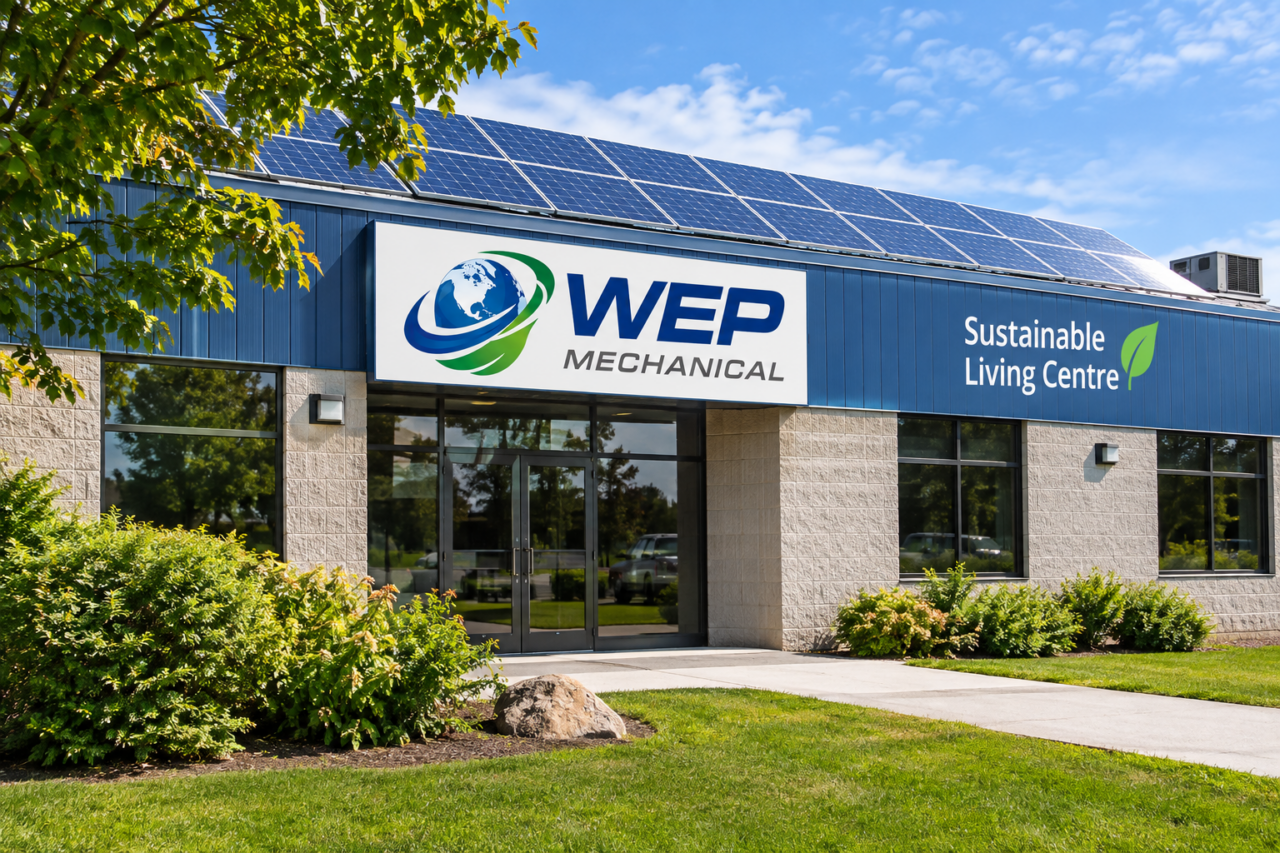
In Mary Hill, Ontario, WEP Mechanical has spent years demonstrating that approach through its own Sustainable Living Centre. The facility offers a practical example of how geothermal heating, air-source heat pumps, solar energy, and thoughtful building improvements can work together.
An Unlikely Beginning for an Energy-Efficient Building
The WEP Mechanical Sustainable Living Centre serves as the company’s headquarters and a working demonstration facility in Waterloo Region.
Its history began long before the building became associated with energy efficiency.
During an interview with host Doug Picklick on HPAC Magazine’s Business Disruptors podcast, Jim Bolger explained that the building was originally constructed in 1970 and later operated as a lighting-company facility.
After that business failed, WEP’s founding partners purchased the property in 2009.
Rather than constructing a new demonstration building, they saw an opportunity to transform an aging commercial property into a place where efficient mechanical technologies could be installed, operated, and demonstrated.
Transforming 7,000 Square Feet Into a Working Demonstration
According to Bolger, the approximately 7,000-square-foot building was relatively basic when the partners acquired it.
It had bare block walls, concrete floors, and two suspended gas furnaces providing heat. These conditions presented several opportunities to improve the building’s efficiency.
The transformation involved multiple upgrades:
- Adding insulation where practical to reduce unwanted heat transfer.
- Replacing or upgrading heating and cooling equipment.
- Installing solar electricity generation.
- Converting lighting to energy-efficient LED technology.
- Improving the building’s overall energy performance.
These improvements addressed different aspects of building operation.
Insulation helps reduce heating and cooling demand, while efficient mechanical equipment supplies the required comfort more effectively. LED lighting reduces electricity consumption associated with illumination.
The project demonstrates why energy-efficient buildings require more than a single equipment replacement.
Geothermal and Air-Source Heat Pumps Working in the Same Building
One particularly useful feature of the Sustainable Living Centre is its operation of two different heat pump technologies.
A geothermal heating and cooling system serves one end of the building.
Geothermal systems exchange heat with the ground through a ground-loop system. Because underground temperatures are relatively stable compared with outdoor air temperatures, geothermal technology can provide efficient heating and cooling across changing seasons.
Another portion of the facility uses an air-source heat pump system.
Air-source heat pumps transfer heat between the building and outdoor air. They provide heating during colder weather and cooling during warmer conditions, with performance depending on equipment specifications and operating temperatures.
Importantly, these are two separate systems serving different areas of the building, not one combined mechanical system.
Operating both technologies gives WEP Mechanical firsthand experience with their applications and practical operating considerations.
For Waterloo Region homeowners, the distinction matters because geothermal and air-source systems have different installation requirements, site considerations, and upfront costs.
What Does It Cost to Operate an Energy-Efficient Building?
One of the most interesting details from Bolger’s interview concerns the facility’s reported operating expenses.
For the approximately 7,000-square-foot building, he reported annual operating costs of roughly $7,000 to $7,500.
He also described annual solar electricity revenue of approximately $11,000, plus or minus.
These figures reflect Bolger’s observations during the podcast interview and should not be interpreted as independently verified financial results or necessarily as current operating figures.
There is also an important reason behind the solar revenue.
The Sustainable Living Centre benefits from a legacy microFIT contract that reportedly pays approximately 80.2 cents per kilowatt-hour for generated solar electricity.
That historical compensation arrangement contributes substantially to the facility’s favourable operating cash flow.
New solar installations should not be expected to receive the same payment rate or produce comparable financial results.
The building’s reported performance illustrates how multiple efficiency measures and a particular historical energy contract can influence operating economics.
It does not establish typical savings, revenue, or investment returns for residential properties.
Why Seeing Energy-Efficient Technology in Action Matters
For many homeowners, geothermal heating and other advanced mechanical technologies remain unfamiliar.
Reading equipment specifications is different from seeing systems installed in an operating building.
Bolger explained that the Sustainable Living Centre has welcomed homeowners, builders, developers, government representatives, and students interested in learning about energy-efficient technology.
He specifically recalled visits involving students from Elmira’s former high-school HVAC program.
Those visits provided opportunities to experience different mechanical technologies firsthand and better understand their applications.
The facility’s educational role also helps explain the potential benefits of geothermal heating in a practical setting.
Instead of relying entirely on theoretical comparisons, visitors can learn how mechanical systems are incorporated into a real building.
That experience can support more informed conversations about technology selection, installation requirements, and long-term operation.
The Biggest Lesson: Equipment Is Only Part of the Solution
Perhaps the most valuable lesson from the Sustainable Living Centre is that building efficiency depends on several connected decisions.
Installing an efficient heat pump does not automatically address poor insulation, excessive heat loss, or unsuitable mechanical distribution.
The Mary Hill project combined building-envelope improvements, updated lighting, mechanical equipment, and solar generation.
Each measure addressed a different operating requirement.
This illustrates why mechanical system design should consider the building as a whole.
For residential projects, that means evaluating heating and cooling loads, insulation, existing equipment, and comfort concerns before selecting a replacement system.
Equipment should be appropriately sized and selected for the conditions it will actually serve.
A coordinated approach can help avoid situations where new technology is installed without addressing underlying building problems.
What Waterloo Region Homeowners Can Learn From the Project
Homeowners in Waterloo, Kitchener, Cambridge, Mary Hill, and surrounding communities do not need a commercial demonstration facility to apply similar principles.
The first step is understanding the existing home.
Consider whether insulation levels are adequate, whether certain rooms experience uncomfortable temperatures, and whether the current heating and cooling equipment meets household needs.
Next, evaluate available heating and cooling options.
Geothermal systems require suitable ground-loop arrangements, while air-source heat pumps have different outdoor equipment and installation considerations.
Existing ductwork, electrical capacity, property characteristics, and renovation plans may also influence equipment selection.
Once a suitable system has been identified, professional heating and cooling installation becomes an important part of achieving reliable operation.
The Sustainable Living Centre demonstrates the value of planning improvements as a coordinated project rather than treating every equipment purchase as an isolated decision.
Its commercial operating figures are not a direct financial comparison for residential homes, but the planning principles remain relevant.
A Building That Reflects WEP Mechanical’s History
The Sustainable Living Centre also reflects the company’s longstanding involvement with efficient heating and cooling technology.
Bolger described beginning his involvement with geothermal technology in 2003.
His original geothermal business eventually joined with other mechanical businesses to establish Waterloo Energy Products.
That background helps explain why the company invested in transforming an older commercial building into a demonstration facility.
Rather than serving only as office space, the property became a place to apply and share practical experience with energy-efficient mechanical systems.
Today, the facility remains an important part of the story behind WEP Mechanical and its interest in improving building comfort and efficiency.
Planning Your Own Energy-Efficient Upgrade?
The Sustainable Living Centre shows how thoughtful planning can bring several building improvements together.
For homeowners, the most useful starting point is not copying the facility’s equipment or expecting similar financial results. It is understanding the home’s existing conditions, comfort challenges, and long-term goals.
Whether considering geothermal heating, an air-source heat pump, or other mechanical improvements, the right approach begins with evaluating the property and its requirements.
Contact WEP Mechanical to discuss how geothermal, air-source heat pumps, and thoughtful mechanical design could improve your Waterloo Region home’s comfort and efficiency.